
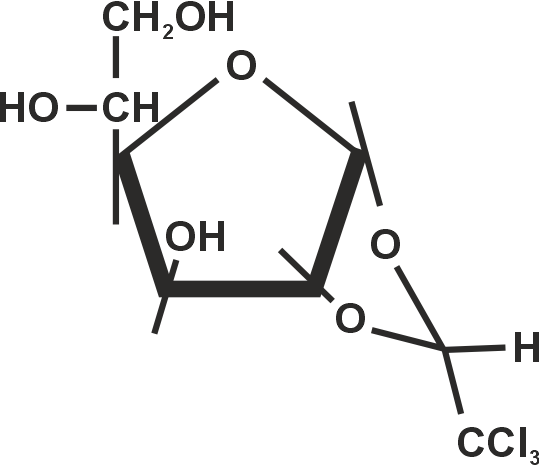
| 1. STRUCTURE | |
|---|---|
 |
| 2. PRODUCT NAME & DETAILS | |
|---|---|
| Product Name | Alpha-d-glucofuranose,1,2-0-(2,2,2-trichloroethylidene)-,(r) |
| Product Code | 002855 |
| CAS No | 15879-93-3 |
| HS Code | 2913.00.90 |
| Molecular Formula | C8H11O6CL3 |
| Molecular Wt. | 309.540 |
| 3. REGULATORY INFORMATION | |||
| Chemical name | Common names and synonyms | CAS number | EC number |
| Chloralose | Chloralose | 15879-93-3 | 240-016-7 |
| European Inventory of Existing Commercial Chemical Substances (EINECS) | Listed | ||
| EC Inventory | Listed | ||
| United States Toxic Substances Control Act (TSCA) Inventory | Listed | ||
| China Catalog of Hazardous chemicals 2015 | Listed | ||
| Chinese Chemical Inventory of Existing Chemical Substances (China IECSC) | Listed | ||
| Korea Existing Chemicals List (KECL) | Listed | ||
| Canadian Domestic Substance List (DSL) | Listed | ||
| Canadian Non-Domestic Substance List (NDSL) | Not Listed | ||
| Japanese Existing and New Chemical Substances Inventory (ENCS) | Not Listed | ||
| 4. SPECIFICATION | |||
| Physical Appearance | White Powder | ||
| Beta-chloralose (by GC) | NMT 15.0% | ||
| Melting Point | NLT 178-184°C | ||
| Moisture Content (KF) | NMT 0.50% | ||
| Solubility 2.5% in Methanol | Clear Solution | ||
| Sulphated Ash | NMT 0.10% | ||
| pH 5% In Water | 6.5 to 7.5 | ||
| Assay (GLC) [Alpha-chloralose+ Beta-chloralose] | NLT 99.0% | ||
| 5. APPLICATION | - Alpha Chloralose is used in baits to kill mice. - The rats and mice menace is effectively controlled by Alpha chloralose loaded baits. - This allows rats and mice to come out of hiding before they are killed. - Alpha Chloralose is also used by farmers as an avian repellent to save crops. - In 1992, the United States Department of Agriculture's Wildlife Services (WS) program received approval from the United States Food and Drug Administration (FDA) to use alpha-chloralose (AC) to capture nuisance waterfowl (Anatidae), American coots (Fulica americana), and pigeons (Columba livia). We summarized use of AC by the WS program to capture nuisance birds during 1994-1995. WS biologists used AC to capture 3,767 birds during 124 operations in 19 states. Captured birds included wild mallards (Anas platyrynchos, 20%), domestic mallards (24%), muscovies (Cairina moschata, 5%), Canada geese (Branta canadensis, 10%), domestic geese (8%), coots (27%), pigeons (5%), and other (<1%). The proportion of birds present at a site that were captured was less for pigeons (6%) than for waterfowl and coots (≥68%). Overall mortality of target birds was 5%, ranging from 0.1% (n=1,014) for coots to 67% (n=3) for mute swans (Cygnus olor). In addition, 102 nontarget birds were captured, of which there was 12% mortality. States with the greatest number of AC operations were Tennessee (14%), Georgia (12%), and California, Nevada, and Oregon (10% each). Most nuisance situations were at parks (39%), followed by golf courses and resorts (19%), and residential areas (17%). Capture operations were most frequent during March-April (29%) and least frequent during October-January (19%). AC is an effective tool to remove nuisance ducks, geese, and coots from situations where other techniques are impractical. We recommend additional research to improve existing techniques and to expand use of AC to capture other nuisance species. - As per the proceedings of the 16th Vertebrate Pest conference (1994) February 1994, BIRD CONTROL IN NEW ZEALAND USING ALPHA CHLORALOSE AND DRC 1339. As per report Horticulturists and general public in New zealand experienced increase problem with a number of introduced birds species. This was meant that many people wish to carry out bird control operation themselves to reduce the problems these birds caused. Most of this control was to be carried out by grower themselves. ALPHA CHLORALOSE is the only known toxin the general public have access to for controlling birds. It is available in a veriety of baits form with a maximum loading of Alpha chloralose 2 % (w/w). | ||
| 6. HAZARD CLASSIFICATION | Hazardous substance. (UN No. 3259)  Acute Toxic  Health Hazard  Environmental Hazard | ||
| 7. ANNUAL CAPACITY | 60 MT. | ||
| 8. STORAGE CONDITION | Store in closed container at ambient temperature. Avoid direct sunlight. | ||
| 9. PACKING DETAILS | STD Pack Size : 20 kg Net Wt. Corrugated Boxes One Pallet Size : 18 x 20 kg Corrugated Box = 360 kg Total Quantity in 20' container : 10 Pallets x 360 Kg = 3600 kg Total Quantity in 40' container : 20 Pallets x 360 Kg = 7200 kg | ||
| 10. SHELF LIFE | 3 years. |
| Disclaimer |
|---|
| Typical properties should not be considered as specification. Product covered by valid patents are not offered or supplied for commercial use. The Patent position should be verified by the customer. Products will not be supplied to countries where they could be in conflict with existing patents. Products currently covered by valid US patents are offered for R&D use in accordance with 35 USC 271 (e) (I) Above information is given in good faith and without warrenty. |
The above information is given in good faith and is without warranty
Q1: What is Alpha Chloralose and what are its main applications?
A1: Alpha Chloralose (C8H11O6Cl3, mol. wt. 309.54) is a chlorinated glucofuranose compound (white powder, assay NLT 99% by GLC) used primarily in rodenticide baits to control rats and mice, and as an avian repellent to protect crops from birds. It has also been approved by the US FDA for use in capturing nuisance waterfowl, coots, and pigeons.
Q2: What beta-chloralose content is permitted in Alpha Chloralose, and why does it matter?
A2: Beta-chloralose content is controlled at NMT 15.0% by GC. The alpha isomer is the desired active form; excessive beta-chloralose reduces biological efficacy in pest-control applications and is considered an impurity that must be kept below the specified limit.
Q3: What is the hazard classification for Alpha Chloralose and how must it be shipped?
A3: It's classified as a hazardous substance (UN No. 3259) with GHS classifications for Acute Toxicity, Health Hazard, and Environmental Hazard. It must be shipped using UN-approved packaging and with appropriate safety documentation — unlike most other Sarex pharmaceutical intermediates which are non-hazardous.
Q4: What regulatory inventories list Alpha Chloralose?
A4: It has unusually broad regulatory listing — covered on EINECS, EC Inventory, US TSCA, China Catalog of Hazardous Chemicals, China IECSC, and Korea KECL — making it one of the most globally recognized fine chemicals in Sarex's portfolio.
Q5: Is Sarex a manufacturer and exporter of Alpha Chloralose for pest-control applications worldwide?
A5: Yes, Sarex manufactures Alpha Chloralose at 60 MT annual capacity in India and, as a leading fine chemical exporter, distributes it globally in 20 kg corrugated boxes (3,600 kg per 20-foot container) to pest management, agricultural, and wildlife management customers in more than 40 countries.