
Plastics exposed to sunlight face a slow but relentless enemy: photo-oxidation. UV radiation breaks down polymer chains, causing discoloration, brittleness, and premature failure. To counter this, manufacturers rely on UV absorbers and among the available chemistries, Triazines have emerged as the preferred choice for demanding applications. Sarex has built a dedicated portfolio around this chemistry, offering formulators a reliable path to longer-lasting, better-protected polymer products.
What Makes Triazine UV Absorbers Different
Triazine UV absorbers, more specifically Hydroxy Phenyl Triazine (HPT) based compounds, work by absorbing harmful UV radiation and dissipating it as heat before it can degrade the polymer matrix. What sets them apart from older chemistries like Benzotriazoles and Benzophenones is their spectral efficiency. Triazine UV absorbers show their strongest absorption around 300 nm, with two absorption maxima — a strong peak near 300 nm in the short-wave UV range and a weaker one around 340 nm in the long-wave range. This dual-band coverage gives polymers broader protection across the UV spectrum than single-peak absorbers can offer.
Low Volatility, Low Migration
One of the biggest challenges with UV absorbers is retention — additives that evaporate or migrate out of the polymer over time stop protecting it. Triazine-based UV absorbers have very low vapor pressure, which keeps physical loss through evaporation minimal even at high processing temperatures. They also exhibit low leaching and low migration, meaning the additive stays where it's needed throughout the product's service life rather than surfacing or washing away. This combination of thermal stability and retention is a major reason processors are shifting toward Triazine chemistry for high-value, long-life applications.
Performance Across Polymer Types
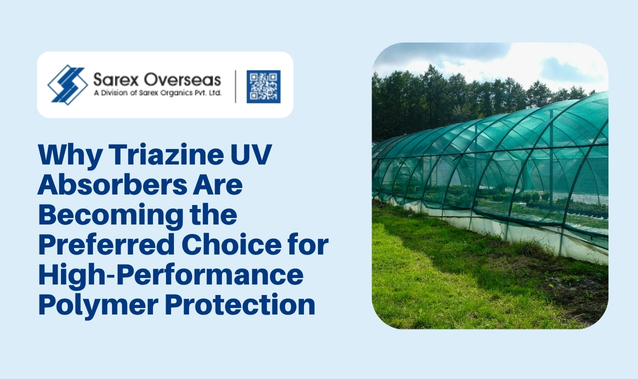
Triazine UV absorbers are compatible across a wide range of polymer systems, making them versatile for formulators working across industries. In polyethylene sheets used for agricultural and greenhouse films, specific grades are chosen for their ability to withstand prolonged outdoor exposure without breaking down. In engineering plastics and technical polymers, HPT-based grades support colorfastness and structural integrity where UV exposure would otherwise shorten product life significantly. This adaptability across film, sheet, and molded polymer applications is part of what makes Triazines a go-to solution rather than a niche additive.
The APPOLO Range from Sarex
Under its APPOLO brand, Sarex manufactures a range of Triazine-based UV absorbers designed for different performance requirements. The range spans grades built for general-purpose UV protection through to specialized HPT-series absorbers engineered for higher thermal stability and extended outdoor life. Because these are Hydroxy Phenyl Triazine structures, formulators get the benefit of strong dual-band UV absorption alongside the low volatility and low migration that make Triazines suitable for demanding, long-service-life products — from greenhouse films to technical plastics that need to hold their properties for years in the field.
Why Formulators Are Making the Switch
The shift toward Triazine UV absorbers isn't just about better UV blocking it's about total cost of protection. Additives that degrade, evaporate, or migrate need to be reapplied or compensated for with higher dosing, adding cost and complexity to formulations. Triazines reduce that burden by staying stable and effective for longer, which means formulators can often achieve the same or better protection at optimized dosage levels. For industries where product failure due to UV degradation carries really financial and reputational cost agriculture films, automotive components, outdoor furniture, and packaging this reliability is what's driving adoption.
As polymer applications continue to demand longer service life under harsher environmental exposure, Triazine-based UV absorbers are positioned to remain the preferred choice for formulators who need consistent, high-performance protection. With over 35 + years of manufacturing expertise behind its additive portfolio, Sarex continues to expand its APPOLO range to meet the evolving needs of polymer processors seeking dependable, long-term UV stabilization solutions.