
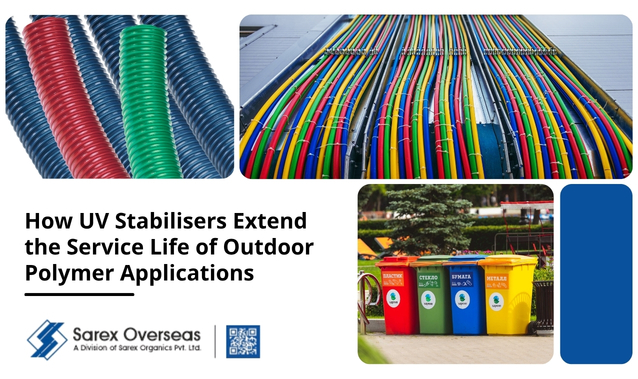
Every polymer product used outdoors is fighting a slow, invisible battle. Sunlight, heat, and environmental exposure work together to break down polymer chains, strip colour, and compromise structural integrity — often long before the product has served its intended purpose. UV stabilisers are the primary defence against this degradation, and choosing the right stabilisation chemistry is one of the most consequential decisions a formulator can make. Sarex, as a manufacturer of advanced Triazine-based UV absorbers and light stabilisers, has been at the forefront of developing solutions that give outdoor polymer applications the longevity they demand.
What UV Degradation Actually Does to Polymers
When polymers are exposed to UV radiation, the energy absorbed triggers a chain of photochemical reactions. These reactions generate free radicals that attack the polymer backbone, leading to chain scission and cross-linking. The visible results are familiar: chalking, yellowing, surface cracking, loss of gloss, and ultimately mechanical failure. What makes UV degradation particularly damaging is its cumulative nature — each hour of sun exposure adds to a growing deficit that no downstream treatment can reverse.
For outdoor applications automotive parts, construction profiles, agricultural films, outdoor furniture, pipes, and cables this degradation timeline directly determines product lifespan and replacement cost.
How UV Stabilisers Intervene
UV stabilisers work by interrupting the degradation process at different stages. The two primary categories are UV absorbers and HALS (Hindered Amine Light Stabilisers), and in most high-performance systems, both are used together.
UV absorbers function by intercepting UV radiation before it reaches the polymer chain. They absorb the harmful energy and release it as harmless heat, effectively acting as a sacrificial shield for the base material. Triazine-based UV absorbers are considered the most effective chemistry in this category — offering broader UV absorption range, higher thermal stability, and lower volatility compared to older benzophenone and benzotriazole chemistries. This makes them especially suited to applications where processing temperatures are high and outdoor exposure is prolonged.
HALS operate differently. Rather than absorbing UV radiation, they scavenge the free radicals generated during photo-oxidation, breaking the degradation cycle before it causes irreversible polymer damage. HALS are catalytic in nature, meaning they are not consumed in the process and continue providing protection over extended periods. This sustained action makes them particularly valuable in long-life outdoor applications.
Why the Stabiliser System Matters as Much as Individual Components
Selecting a single UV stabiliser and calling the formulation complete is a common and costly mistake. The most durable outdoor polymer systems use a carefully balanced stabiliser package — UV absorbers to block incoming radiation, HALS to neutralise reactive species, and antioxidants to manage thermal degradation during both processing and service life.
The ratio, compatibility, and interaction between these components determine the real-world performance of the final product. Getting this formulation balance right requires both deep chemistry knowledge and hands-on production experience.
Applications Where UV Stabilisation Is Critical
Outdoor polymer applications that depend heavily on UV stabilisation include agricultural films, automotive exterior components, construction membranes, geomembranes, outdoor pipes and fittings, wire and cable jacketing, and garden furniture. In each case, the expected service life runs from several years to over a decade — timelines that are simply unachievable without a robust UV stabilisation system built into the formulation from the start.
Building Longevity into Every Formulation
The shift in the industry is clear polymer producers and compounders are increasingly looking beyond price-per-kilogram and evaluating additive partners on the basis of technical depth, formulation support, and consistency of supply. By working with a manufacturer like Sarex, compounders gain not just a chemical input but a formulation partner committed to extending the performance life of every product they produce.